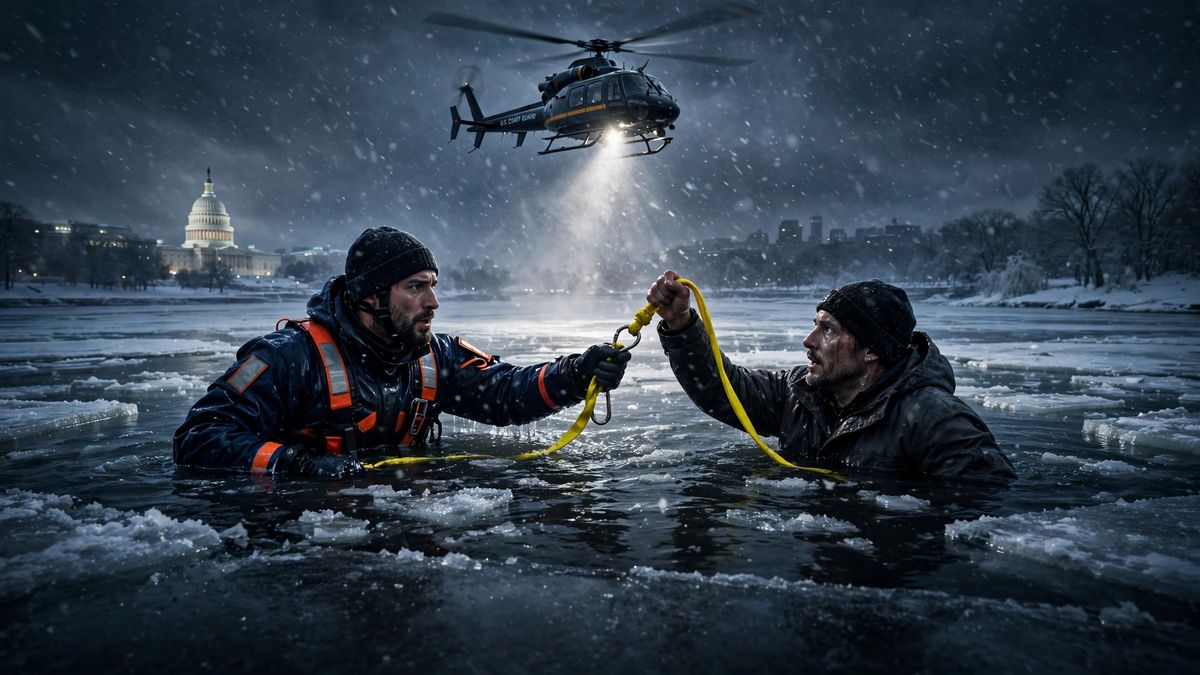
January 13, 1982, was a day of blinding snow in Washington, D.C. Air Florida Flight 90, bound for Florida, struggled into the air from National Airport with ice on its wings, failed to climb, and smashed into the 14th Street Bridge before plunging into the frozen Potomac River. Of the 79 people aboard, almost all were killed. But in the wreckage, in water so cold that survival was measured in minutes, six people were still alive — clinging to the tail section of the broken plane.
The helicopter and the line
A United States Park Police helicopter arrived, flown by pilot Donald Usher with paramedic Gene Windsor hanging out of the door. They lowered a lifeline to the survivors, one rescue at a time. Windsor later described how, again and again, the line reached one particular man — and how that man, instead of wrapping it around himself, passed it to the person next to him.
It happened not once, but over and over. The helicopter carried survivor after survivor to the shore, where bystanders — including another hero of that day, Roger Olian, who repeatedly entered the water himself — pulled them out. Each time the line went back down to the man in the water. Each time, he gave it away. Five people owed their lives to those handoffs.
The sixth seat
When the helicopter returned for the man himself, he was gone. The wreckage had shifted, and the river had closed over him. He was the only one of the six who had been alive in the water and did not come home.
For days, nobody knew his name. The rescuers spoke of an unknown, balding man who had performed one of the purest acts of selflessness ever witnessed — and the country wanted to know who he was. When the wreckage was raised, he was identified: Arland D. Williams Jr., 46 years old, a bank examiner from Atlanta, a father of two, traveling on business. Just an ordinary man, in an ordinary seat, on an ordinary flight — until the worst moment of his life revealed something extraordinary.
The rescuers said it simply: he gave his life so that others could live. There was no calculation in it. The line came, and he passed it on.
A bridge with his name
President Ronald Reagan honored Williams in his State of the Union address that year, and the repaired 14th Street Bridge was renamed the Arland D. Williams Jr. Memorial Bridge — so that everyone who crosses the Potomac at that spot passes over the place where a stranger decided, five times in a row, that someone else's life mattered more than his own.
How the world learned his name
Because the man in the water had never given his name, investigators had to identify him by elimination: when the wreckage was recovered and every other person in the water was accounted for, only Arland Williams remained. His family, watching the famous rescue footage at home in Georgia, had already begun to fear — and then to know — who the unknown hero was. The tributes were extraordinary. The United States Coast Guard awarded him its Gold Lifesaving Medal posthumously, and he received the Carnegie Medal for heroism. At the Citadel, his alma mater, his story became part of how cadets are taught the meaning of duty. President Reagan, honoring him before Congress, said that Williams had shown "the spirit of American heroism at its finest" — and that the nation would always be proud of him. But perhaps the most fitting memorial is the simplest: the hundreds of thousands of commuters who cross the Arland D. Williams Jr. Memorial Bridge every week, most unaware that the name on the sign belongs to a man who died within sight of that very shore, giving his rescue away.
We cannot know what Arland Williams was thinking in that freezing water. We only know what he did. In the very last minutes of his life, offered rescue again and again, he kept giving it away — and that is why, more than forty years later, his name is still spoken with reverence: the man who passed the ring.