In December 1938, Nicholas Winton was a 29-year-old London stockbroker packing for a skiing holiday in Switzerland. Then a friend called from Prague and told him to cancel the trip and come quickly. What Winton found in Czechoslovakia changed his life: camps full of families who had fled the Nazis, living in mud and freezing cold — and thousands of children whose parents were desperately looking for a way to get them out before it was too late.
A desk, a telephone, a race against time
Britain had begun accepting child refugees through what became known as the Kindertransport, but no one had organized an operation from Prague. So Winton did it himself. From a hotel room and later a small office, he and a handful of helpers collected children's names and photographs, found foster families in Britain willing to take them in, and battled through the paperwork: every child needed a British family, a £50 guarantee, and official permission to travel.
Back in London, Winton worked his stockbroking job by day and ran the rescue by night, writing hundreds of letters and appeals. His mother helped him at home. Money was raised coin by coin. It was unglamorous, exhausting, bureaucratic work — and every finished file meant one more child on a train.
Eight trains
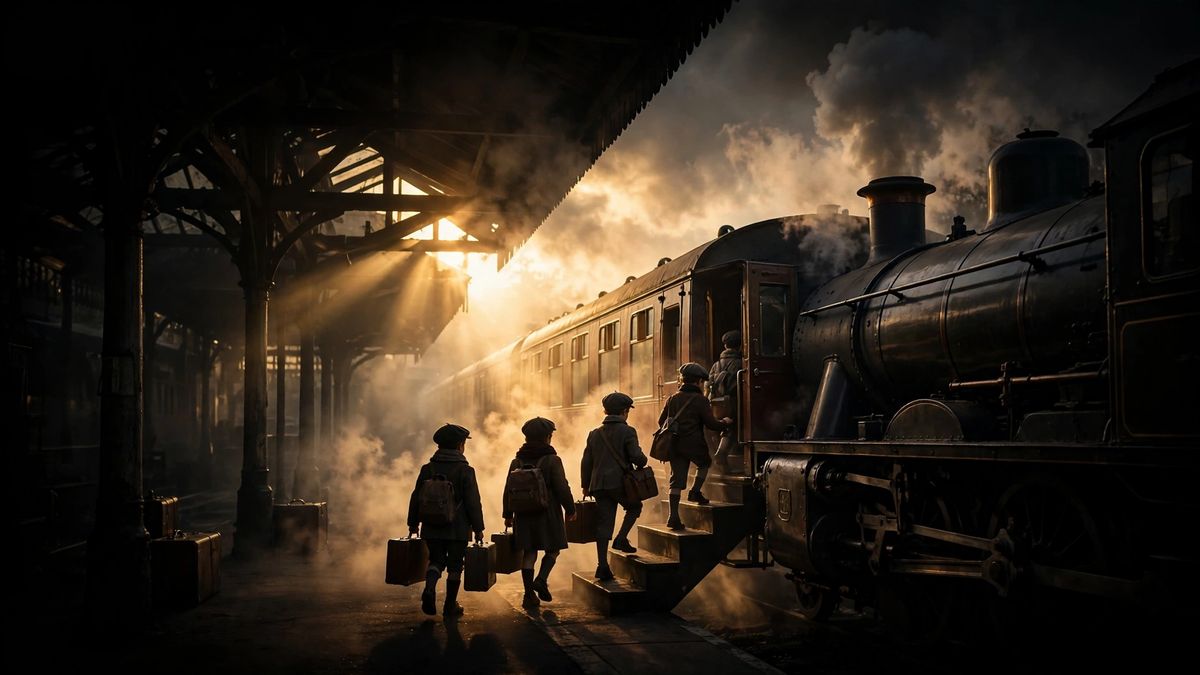
Between March and August 1939, eight trains left Prague carrying children — most of them Jewish — through Germany and Holland to the Hook of Holland ferry, and on to Liverpool Street Station in London, where foster parents waited on the platform. In total, 669 children made the journey to safety.
A ninth train, the largest of all, was scheduled to leave on September 1, 1939, with 250 more children aboard. That morning, Germany invaded Poland. The train never left the station, and almost none of those 250 children survived the war. Winton carried that loss quietly for the rest of his life.
"If it is not impossible, then it must be done." It was the closest thing Nicholas Winton had to a motto — and he lived by it.
The scrapbook in the attic
After the war, Winton married, raised a family, and got on with life. He almost never spoke about Prague. The rescue sat in a scrapbook in his attic — lists of names, photographs of children, letters from parents — for nearly fifty years.
Then, in 1988, his wife Grete found the scrapbook and showed it to a historian. The story reached the BBC programme That's Life!, and Winton was invited to sit in the studio audience, told only that his work would be mentioned. Partway through the show, the presenter, Esther Rantzen, asked whether anyone in the audience owed their life to Nicholas Winton. The woman sitting beside him stood up. Then the whole studio stood up. Dozens of the children he had saved — now grown, with children and grandchildren of their own — were all around him, and he had had no idea.
"Nicky's children"
The people Winton saved became known as "Nicky's children." Today their descendants number in the thousands — an entire forest of lives that grew from eight trains and one man's refusal to look away. Winton was knighted in 2002 and celebrated his 100th birthday at the Czech embassy, surrounded by some of the children he had rescued. He died in 2015, at the age of 106 — on July 1, the anniversary of the day the largest of his trains had reached London in 1939.
He never thought of himself as a hero. He was, he insisted, just a man who saw something that needed doing, and did it. Perhaps that is exactly what a hero is.