In 1951, a 14-year-old Australian boy named James Harrison underwent major chest surgery. A lung was removed, and to survive the operation he received litre after litre of donated blood from strangers he would never meet. When he woke up and learned what had kept him alive, he made a quiet promise: when he was old enough, he would give the blood back.
A promise kept for 60 years
Harrison turned 18 in 1954 and walked into a Red Cross donation centre, true to his word — even though he couldn't stand the sight of needles. He looked away every single time, for more than sixty years. He donated whole blood at first, then plasma, as often as the rules allowed: roughly every two weeks, year after year, decade after decade. In the end, he rolled up his left sleeve 1,173 times.
The rarest kind of gift
Doctors soon discovered that Harrison's blood was extraordinary. It carried an unusually strong antibody called anti-D. At the time, Australia was losing thousands of babies to rhesus disease — a condition in which a mother's immune system attacks her unborn baby's blood. It caused stillbirths, brain damage and heartbreaking loss, family after family.
Harrison's plasma became the key ingredient in anti-D immunoglobulin, an injection given to mothers at risk so their babies would be safe. Because one man kept showing up, appointment after appointment, Australia was able to produce the treatment for the whole country. The Australian Red Cross estimates that Harrison's donations helped protect around 2.4 million babies — including, fittingly, his own grandson, whose mother received the anti-D injection made possible by her father's blood.
He never knew the families. He just knew that somewhere, a mother was holding a healthy baby — and that was reason enough to keep going.
The last donation
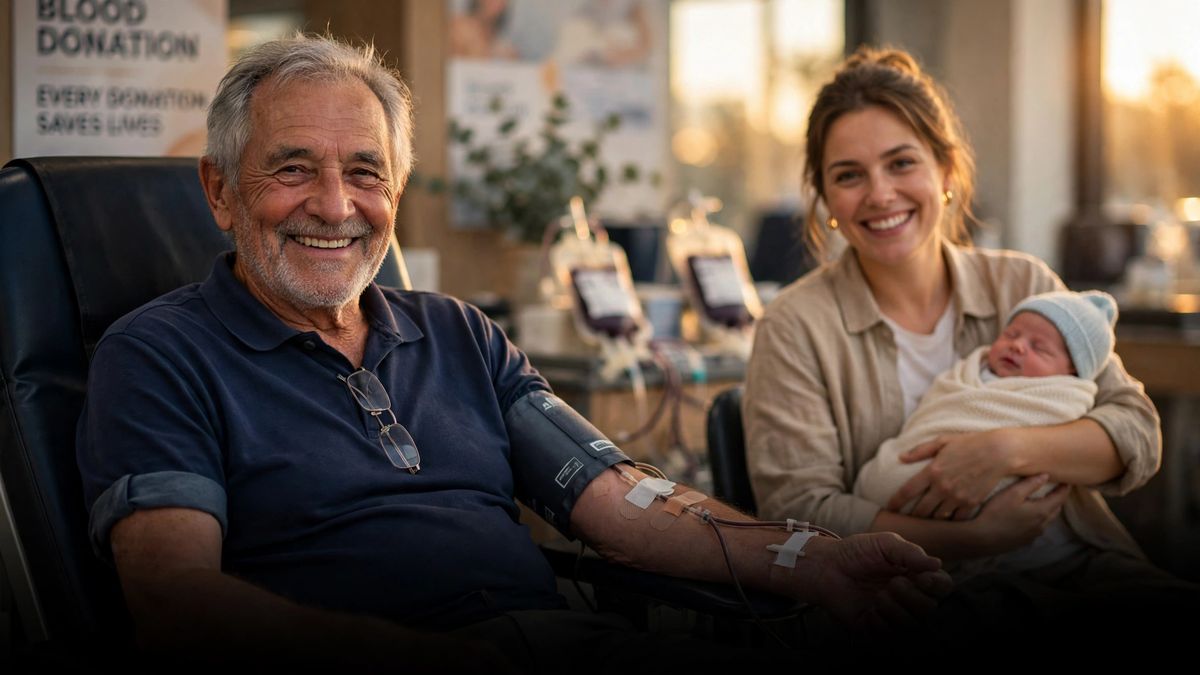
Australia retires its donors at 81, so on May 11, 2018, James Harrison made his final donation, surrounded by nurses, balloons, and mothers holding babies his blood had saved. He admitted he was sad to stop — and characteristically, he said he wished they would let him keep going. By then he held the world record for blood plasma donated, and Australians knew him by a nickname that said it all: the Man with the Golden Arm.
A one-man national program
For decades, Harrison was not just a donor — he was, in a sense, a national health program of one. Only a tiny fraction of donors carry anti-D in useful strength, and Harrison's levels were exceptional, so virtually every batch of anti-D produced in Australia for more than half a century began with his plasma. He gave at the same Sydney donation centre for most of his life, always with his left arm — his famous "golden arm" — and always looking the other way. Researchers who worked with his blood also used it to help develop improved treatments, meaning his contribution runs through the science as well as the supply. When he began, rhesus disease was a common cause of grief in Australian maternity wards. By the time he retired, it had become rare — a transformation doctors openly say could not have happened without him.
Harrison died in February 2025, at the age of 88, in a nursing home on the New South Wales Central Coast. He left no fortune and sought no fame. What he left behind is measured differently: in millions of birthday candles, first days of school, and family photographs — in lives that quietly happened because a teenager who owed his life to strangers decided to spend sixty years saying thank you.