In January 1925, the remote gold-rush town of Nome, Alaska, was locked in by winter ice — no ships could reach it, and its one airplane could not fly in the cold. Then the town's only doctor diagnosed the nightmare: diphtheria, a disease that suffocates children, was spreading among Nome's families. The town's small supply of antitoxin had expired. Without fresh serum, doctors feared an epidemic that could wipe out much of the town's population of about 1,400 people, many of them Alaska Native families with no immunity at all.
The Great Race of Mercy
The nearest serum was in Anchorage, nearly a thousand miles away. It could travel by train as far as Nenana — but from there, the only road to Nome was the Iditarod mail trail: 674 miles of frozen rivers, tundra and mountain passes, in temperatures plunging to minus 50 and below. The answer was a relay — twenty mushers and more than a hundred and fifty sled dogs, passing the precious, freeze-sensitive package of serum from team to team, day and night, through the dark of the Alaskan winter. Newspapers across America followed it breathlessly: the Great Race of Mercy.
Many heroes ran in that relay — most famously Leonhard Seppala and his legendary lead dog Togo, who covered the longest and most dangerous leg of all, some 260 miles, including a shortcut across the treacherously freezing Norton Sound. But the final leg fell to musher Gunnar Kaasen and his team, led by a young Siberian Husky named Balto.
Through the white darkness
Kaasen's team took the serum for the last 53 miles — and ran straight into a ground blizzard so violent that Kaasen could not see his own dogs, let alone the trail. The wind flipped the sled and sent the serum tumbling into a snowbank; Kaasen dug for it with his bare hands until he found it. In those conditions, the team was no longer guided by the man. It was guided by Balto — following the trail by scent and instinct through the whiteout, mile after mile, until at 5:30 in the morning on February 2, 1925, the team pulled onto Front Street in Nome. The serum was delivered. The epidemic was stopped. And Kaasen's first words were for his dog: "Damn fine dog."
Balto became the face of the serum run — but the run itself belonged to 150 dogs and twenty men, and to Togo, whose even greater feat Balto's fame long overshadowed.
A hero in bronze
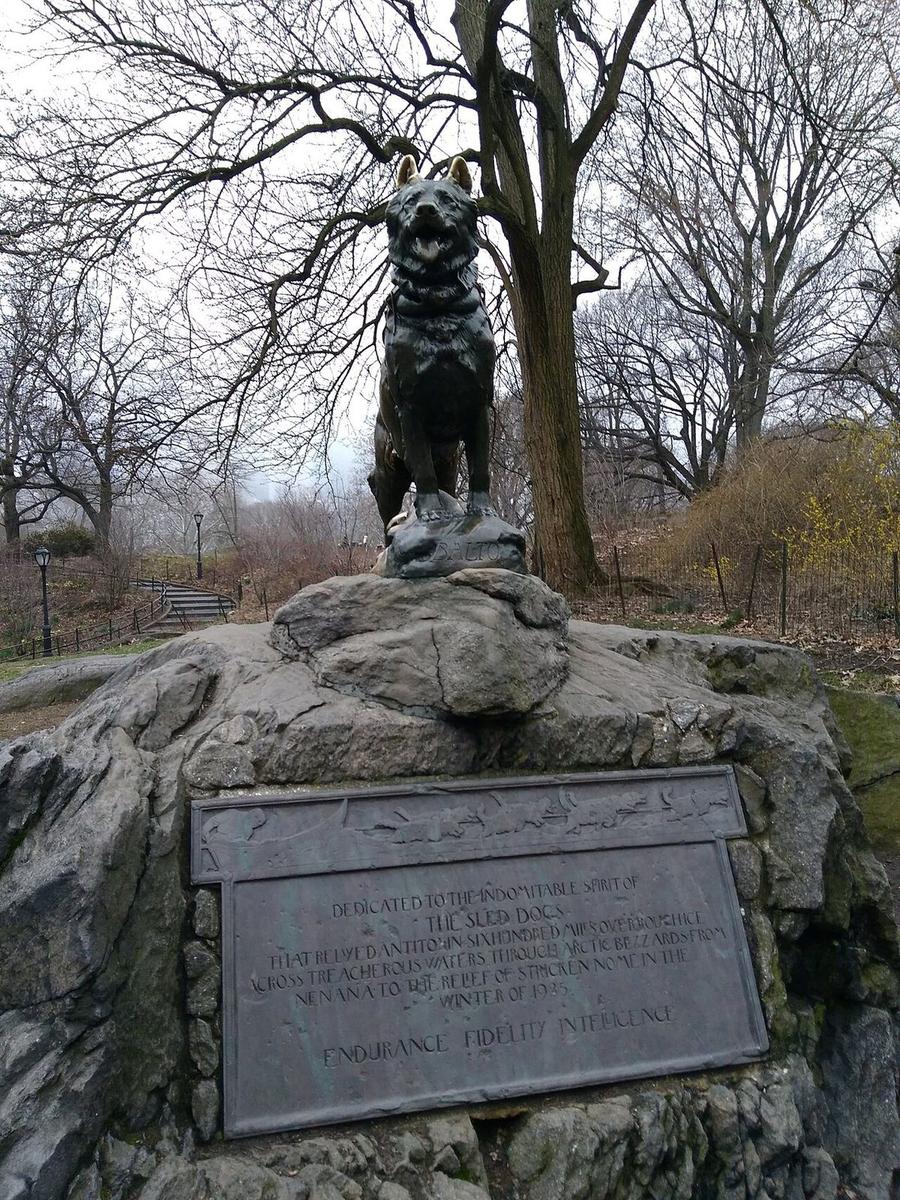
Balto became an overnight celebrity. Within the year, a statue of him was unveiled in New York's Central Park — Balto himself attended the ceremony — and it stands there today, its back worn smooth by a century of children climbing up to hug him. After his fame faded, Balto was rescued from a sideshow by a public campaign in Cleveland and lived out his days honored at the Cleveland Zoo, dying in 1933; his preserved remains rest in the Cleveland Museum of Natural History.
Five and a half days
The numbers of the serum run still stagger: 674 miles, covered in five and a half days, when the same trail normally took a mail team twenty-five. Temperatures along the route fell below minus fifty; wind chills were far worse. The serum, which would be ruined if it froze solid, traveled wrapped in furs and was warmed at roadhouses along the way. Of the relay's many teams, history at first remembered only the last one — a quirk of newspaper deadlines, since Kaasen and Balto arrived when the story climaxed. Justice has been catching up ever since: Seppala's Togo, who ran nearly five times Balto's distance through the deadliest stretch, is now widely honored as the run's greatest dog, with his own statue and, in 2019, a film of his own. The mushers themselves would have insisted on exactly that accounting. The run was never one dog's glory. It was a chain of teams strung across a frozen territory, each trusting the next — and Balto, at the end of the chain, did not break it.
Every March, the Iditarod sled dog race retraces the old trail to Nome in memory of the run. And at its heart remains a simple truth Balto proved in a blizzard: when every machine failed and every road was closed, it was dogs — loyal, tireless, and brave — who carried a town its medicine, and its children their lives.