In the spring of 1942, a group of Polish soldiers traveling through the mountains near Hamadan, in Iran, met a young shepherd boy carrying something extraordinary in his sack: a tiny brown bear cub, starving and alone, whose mother had been killed by hunters. The soldiers — men who had themselves survived deportation to Siberia and were now marching toward a new front — traded some food and a penknife for the cub. They fed him condensed milk from an empty vodka bottle. They named him Wojtek, a name built from the Polish words for a warrior who delights in battle: the joyful soldier.
Raised by an army
Wojtek grew up in military camps across the Middle East, utterly convinced he was one of the men. He marched with them, wrestled with them for sport, learned to salute, and developed a soldier's tastes — he famously enjoyed coffee in the morning and the occasional beer, and would eat lit cigarettes the men fed him as a joke, swallowing them with every sign of pleasure. When he caught a thief who had slipped into camp one night, and when he playfully showered unsuspecting bathers by working the shower chain, his legend grew. He was not a mascot the men kept. He was a comrade they loved.
But in 1944, the Polish II Corps was ordered to Italy — and British transport regulations said no animals could sail with the troops. The soldiers' answer was pure Wojtek logic: they enlisted him. Private Wojtek was officially entered on the rolls of the 22nd Artillery Supply Company, issued a pay book and a serial number, and promoted, in time, to corporal. On paper, he was a soldier. So onto the ship he went.
Monte Cassino
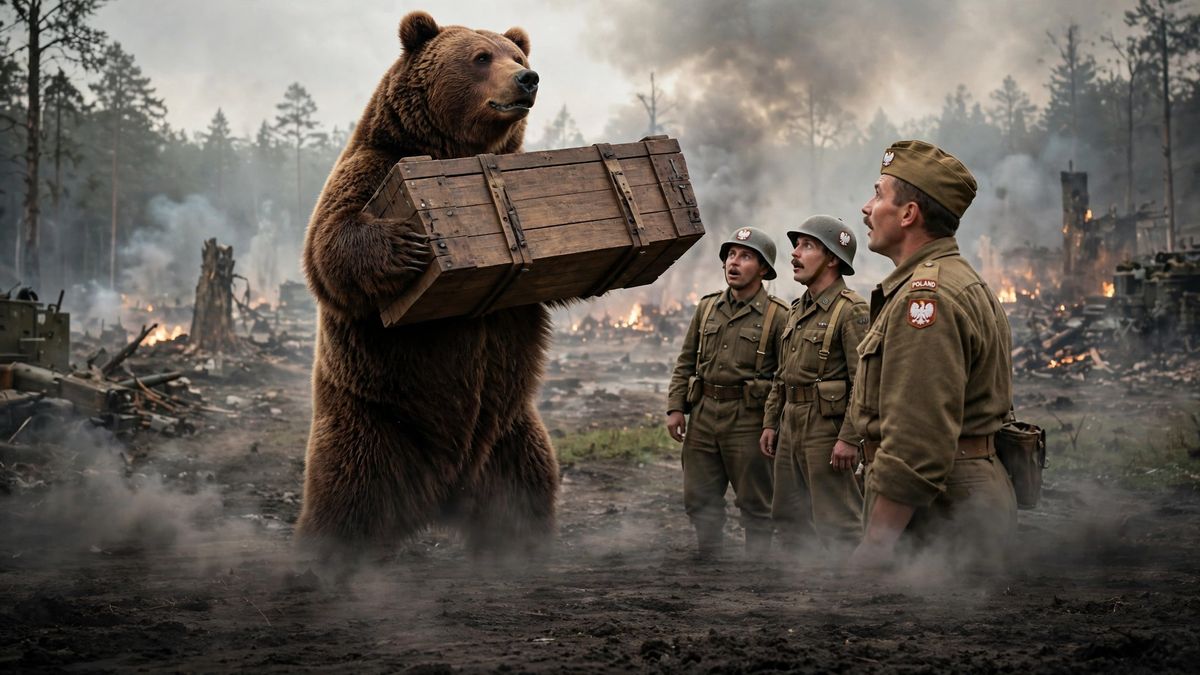
At the Battle of Monte Cassino in May 1944 — one of the hardest fights of the Italian campaign — Wojtek did something that passed into legend. Watching the men strain to unload crates of artillery shells from the trucks, the huge bear rose on his hind legs and held out his paws. The men, astonished, loaded a crate into his arms. Wojtek carried it to the guns. Then he went back for another. All through the battle, witnesses said, he hauled ammunition and never dropped a single crate. The image of a bear carrying a shell became the official emblem of his company, worn on their vehicles and badges.
He could not understand the war. He only understood that his family was working, and struggling — so he picked up a crate and helped.
The soldier who stayed
When the war ended, Wojtek marched with his unit to Scotland. The men were demobilized one by one, and Wojtek — a celebrity by then — was given a home at Edinburgh Zoo in 1947. His old comrades visited him for years, tossing him cigarettes over the fence while he stood up and waved a paw at the sound of Polish voices. He died in 1963, beloved on two continents.
The bear of Edinburgh
Wojtek's postwar years gave his story its bittersweet glow. At Edinburgh Zoo he was one of the most popular residents in Scotland, and his old comrades — Polish soldiers who had settled in Britain rather than return to a Poland under communist rule — came often to see him. Keepers recalled that Wojtek perked up at the sound of Polish, standing at the fence while his visitors tossed him the cigarettes he still loved and spoke to him like the soldier he had been. In 2015, a bronze statue of Wojtek and a Polish soldier was unveiled in Edinburgh's Princes Street Gardens, a short walk from the castle — the joyful soldier, home at last among his friends. There is something in his story that nations keep returning to: an orphan of war, raised by orphans of war, whose whole life argues that family is not only something you are born into. Sometimes it is the unit that feeds you from a bottle, teaches you to salute — and refuses, when the ships sail, to leave you behind.
Today statues of Wojtek stand in Edinburgh, in Poland, and beyond — a bear in bronze, forever mid-stride beside his soldiers. Of all the strange, true stories of that war, his may be the most moving: an orphan raised by exiles, who repaid their kindness the only way he knew how — by standing with them, in the worst place on Earth, and carrying his share of the load.