John Gray was a night watchman with the Edinburgh City Police, and in the 1850s a watchman patrolled with a dog at his side. Gray's companion was a small, shaggy Skye Terrier named Bobby, and for two years the man and the dog were inseparable — on the cold night rounds, at their lodgings, everywhere. Then, in February 1858, John Gray died of tuberculosis. He was buried in Greyfriars Kirkyard, the ancient churchyard in the heart of Edinburgh's Old Town. Bobby followed the funeral. And then, to everyone's astonishment, Bobby simply stayed.
The vigil
The kirkyard's gardener and caretaker tried at first to shoo the little dog away — animals were not allowed. But Bobby always slipped back, curling up on his master's grave in all weathers: rain, frost, and Scottish snow. Moved by the dog's devotion, people nearby began to care for him. Each day at one o'clock, when the time gun fired from Edinburgh Castle, Bobby would trot to a local eating house where he had once gone with his master, and be given his dinner — then return faithfully to the grave. In bad weather, kind neighbors took him in for the night. He always went back.
In 1867, Bobby's vigil nearly ended in tragedy: a new law required all dogs in the city to be licensed, and unlicensed dogs were destroyed. Bobby had no owner to pay for him. When the Lord Provost of Edinburgh, Sir William Chambers — himself a dog lover — heard of it, he paid for Bobby's license himself and presented him with a collar bearing a brass plate, inscribed with his name and the words "from the Lord Provost, 1867." That collar is preserved in a museum today.
Fourteen years
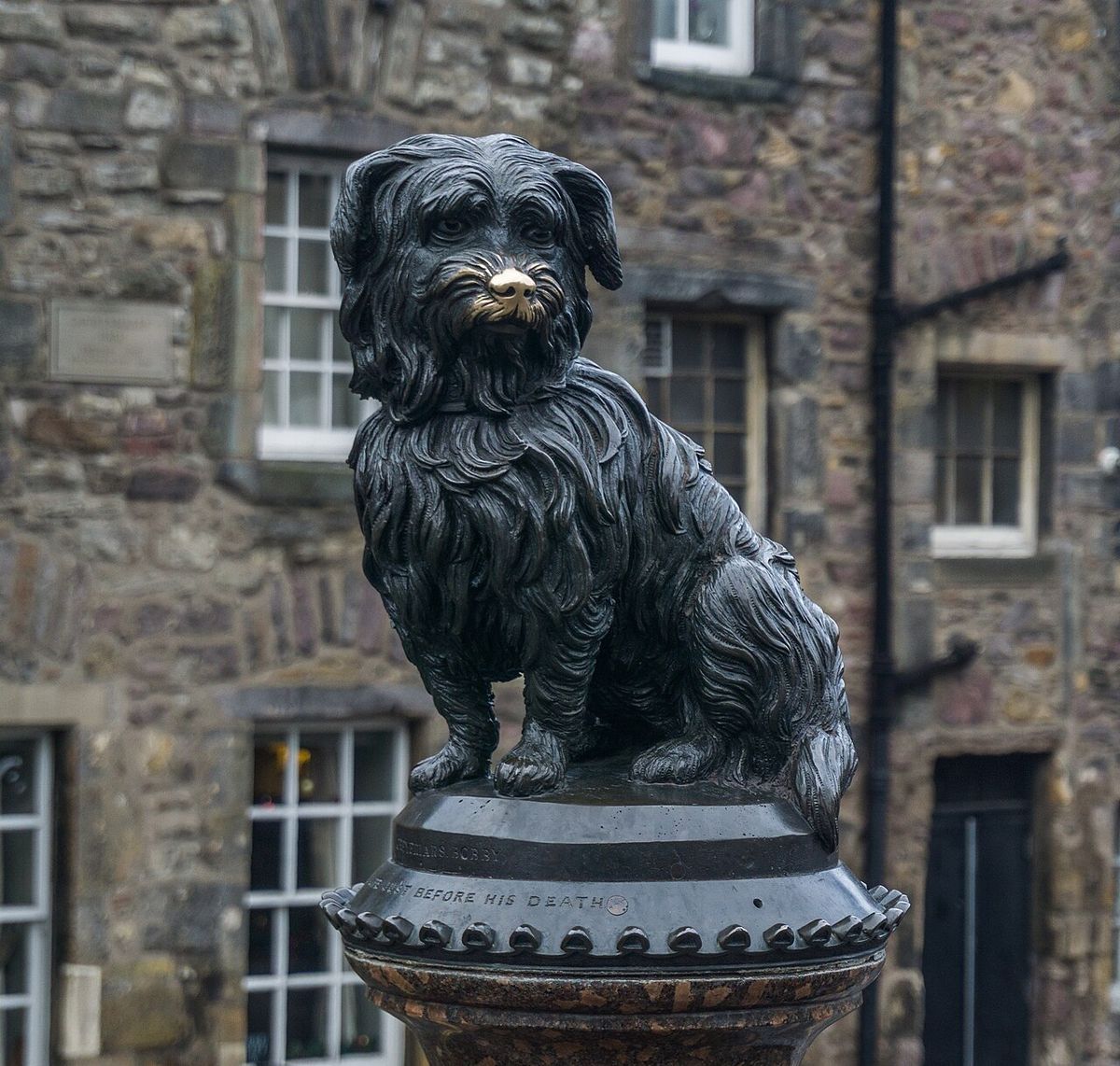
Bobby kept his post for fourteen years — almost certainly one of the longest vigils of devotion ever recorded — until his own death on January 14, 1872. By then he was famous across Britain; crowds had gathered at the kirkyard gates just to watch the faithful little dog make his daily rounds. He was buried just inside the gate of Greyfriars, not far from the master he had guarded, and a year later a memorial fountain topped with Bobby's statue was unveiled nearby, paid for by the philanthropist Baroness Burdett-Coutts. It stands there still, its nose polished bright by the hands of generations of visitors.
Victorians called Bobby the most faithful dog in the world. Edinburgh simply called him theirs.
History, polished by love
Honesty requires a small note: like all beloved legends, Bobby's story was polished in the telling, and historians have debated details ever since — whether he watched one grave or the whole kirkyard, and how the tale grew in Victorian newspapers. But the heart of it is documented fact: a real little dog, a real collar, a real city that fed him and loved him for fourteen years because he would not abandon his friend.
The collar, the stone, the gun
Edinburgh kept the tokens of Bobby's life with unusual care. His collar — the one the Lord Provost paid for in 1867, with its brass inscription — is displayed today in the Museum of Edinburgh, a few streets from the kirkyard. And in 1981, more than a century after his death, the Dog Aid Society of Scotland gave Bobby a proper headstone of red granite, placed just inside the kirkyard gate near his burial spot. Its words have become the city's verdict on him: "Let his loyalty and devotion be a lesson to us all." For generations of Edinburgh children, the one o'clock gun, Bobby's dinner hour, and the little statue with the shiny nose have formed a single story — the first history lesson many of them ever loved, and the one they never forget.
However the details settle, the meaning never changes. A dog's love, once given, does not consult calendars or death certificates. It takes up its post — and it stays.