Emma Rowena Gatewood had already lived several lifetimes by 1955. Raised on an Ohio farm, she married young, raised eleven children, and endured a violent marriage for decades before finally divorcing her husband in 1940 — an almost unheard-of step for a woman of her generation. She worked as a practical nurse and a farmer. And one day, in a doctor's waiting room, she read a National Geographic article about a new footpath called the Appalachian Trail, running some 2,000 miles from Georgia to Maine. The article claimed no woman had ever hiked the whole thing. Emma decided she would like to try. She was in her sixties.
"I'm going for a walk"
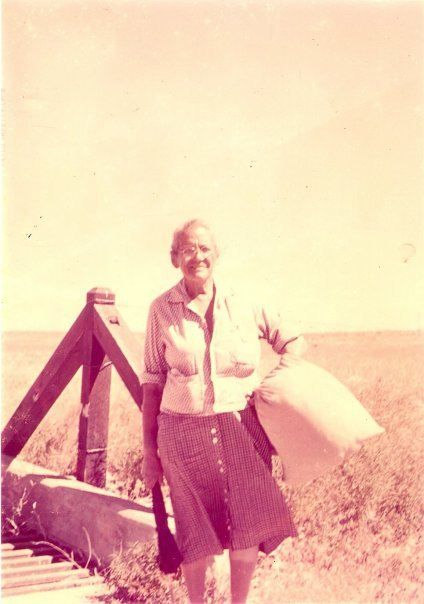
In May 1955, Emma Gatewood kissed her grown children goodbye, telling them only that she was going for a walk — she knew they would try to stop her if they knew the truth. She set out from Mount Oglethorpe in Georgia carrying almost nothing: a homemade denim sack slung over her shoulder holding a blanket, a plastic shower curtain for shelter, a change of clothes, and a few supplies — about seventeen pounds in all. No tent. No sleeping bag. No backpack with a frame. On her feet: a simple pair of canvas Keds sneakers.
She walked. Through rain that soaked her for days, over rocky Pennsylvania ridgelines that shredded her shoes — she wore out pair after pair — foraging berries, accepting kindness from strangers and farmers along the way, sleeping on picnic tables and porches and piles of leaves. When reporters caught up with her and asked why a grandmother would do such a thing, she answered with characteristic plainness: "Because I wanted to." And, she added, she had read it was a lovely trail — and it was supposed to be easy. It was not easy. She climbed Mount Katahdin in Maine on September 25, 1955, 146 days after she started: the first woman ever to hike the entire Appalachian Trail alone in a single season.
She did it again. And again.
Then Emma Gatewood did something even more astonishing: she went back. In 1957 she hiked the whole trail a second time. In 1964, at the age of 76, she completed it a third time, in sections — becoming the first person, man or woman, to hike the Appalachian Trail three times. Along the way she became a beloved national figure — "Grandma Gatewood" — whose fame drew thousands of ordinary people, especially women and older people, to try the trail themselves. Historians credit her with helping to save the young Appalachian Trail from obscurity, and her seventeen-pound sack made her a founding saint of today's ultralight hiking movement.
Her advice to would-be hikers was pure Gatewood: "Just get out there and walk. It's not that hard." From her, somehow, you believed it.
The walk that set her free
Emma Gatewood died in 1973, at 85, having walked thousands of miles in her final decades. Her children said the trail had given their mother something life had long denied her: peace, on her own terms, at her own pace.
More trails, more firsts
The Appalachian Trail was only the beginning of Grandma Gatewood's walking life. In 1959, at 71, she walked the 2,000-mile Oregon Trail route from Missouri to Oregon to honor the pioneers — and to mark the Oregon centennial — becoming the first person known to walk it in a single journey. Back home in Ohio, she helped found the Buckeye Trail Association and blazed sections of the Buckeye Trail through her own beloved Hocking Hills, where the January winter hike she championed still draws thousands of walkers every year along a stretch now named in her honor. She kept walking into her eighties. When people asked her secret — how a great-grandmother with a denim sack outwalked mountaineers — she pointed to the obvious: she walked slowly, she walked steadily, and she did not stop. The mountains, she found, were not conquered. They were simply visited, one at a time, on foot.
Every year now, thousands of hikers set out on the Appalachian Trail — and every one of them walks in the footprints of a great-grandmother in sneakers who proved that it is never too late, and you are never too old, to walk out of the life that hurt you and into a better one, one step at a time.