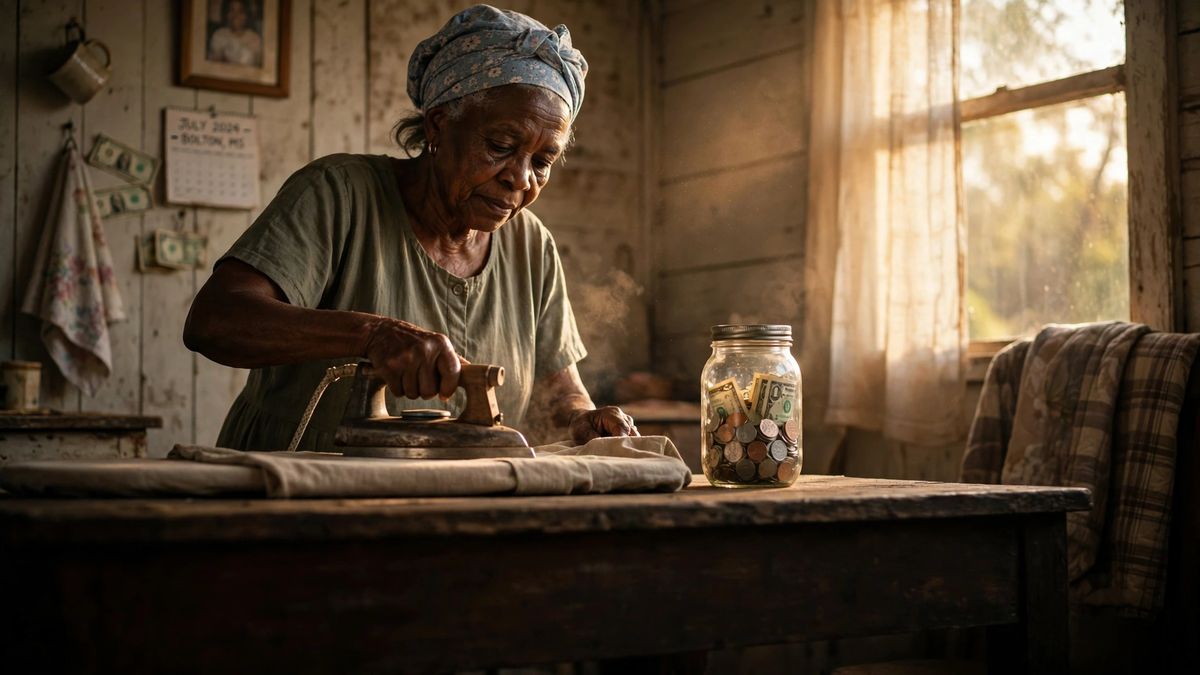
Oseola McCarty was born in 1908 in rural Mississippi, and her schooling ended early: in the sixth grade she left the classroom to care for a sick aunt, and she never went back. For the rest of her working life — some seventy years — she earned her living the hardest way there was: washing and ironing other people's clothes by hand, in a small house in Hattiesburg, for a few dollars a bundle.
One dollar at a time
McCarty lived as simply as a person can. She never owned a car and walked everywhere. She cut her own hair, grew her own vegetables, and bound her Bible with tape when it began to fall apart. Friends who subscribed to magazines for her discovered she had quietly cancelled them to save the money. Every week, she took a portion of her earnings to the bank and put it away — not for anything in particular, just out of a discipline as deep as her faith.
She never married and had no children. By the time she retired in 1995, worn out by arthritis at the age of 87, those small deposits had grown into something astonishing: around $280,000 — a fortune, accumulated a few coins at a time by a woman the world had completely overlooked.
The gift nobody expected
When bank officers helped her plan her estate, McCarty made her wishes plain. Some money would go to her church and to family. But the largest share — $150,000 — she gave to the University of Southern Mississippi, to create a scholarship fund for African American students with financial need. She wanted young people from her own community to have the education she had been denied.
The news stunned the country. Here was a woman who had scrubbed clothes in a washtub giving away more, proportionally, than most millionaires ever do. Donations poured in from inspired strangers, more than tripling her fund. The first scholarship went to a local teenager named Stephanie Bullock — who, when she heard who her benefactor was, went to meet her, and the two became close friends.
"I can't do everything," McCarty said, "but I can do something." It may be the most powerful financial advice ever given.
Honors she never sought
The honors found her anyway: an honorary doctorate from the university she had never attended, the Presidential Citizens Medal presented by President Bill Clinton, and tributes from Harvard and the United Nations. She took it all with gentle bemusement. She was happier, she said, in her little house, with her garden and her church.
"I want to help somebody's child"
People who met McCarty after her gift often asked the same question: why give it to strangers? Her answer never varied. She had always wanted an education, and it had been taken from her by duty and poverty. If her washtub money could open a classroom door for somebody else's child, then every bundle of laundry had been worth it. She arranged her affairs with the same care she had lived them: a tenth to her church, portions to relatives, and the great share to the scholarship. She kept enough to live on — her little house, her garden, her modest comforts — and she insisted, with some bewilderment at the fuss, that she had kept the best part for herself: the joy of giving it. The scholarship's first recipient, Stephanie Bullock, graduated and went on to build a career — the first of a line of students, stretching into the future, who would study because a washerwoman decided they should.
Oseola McCarty died in 1999, at 91. Her scholarships are still awarded every year. And her story keeps asking its quiet question of everyone who hears it: it is not the size of what you have that matters — it is the size of what you are willing to give.