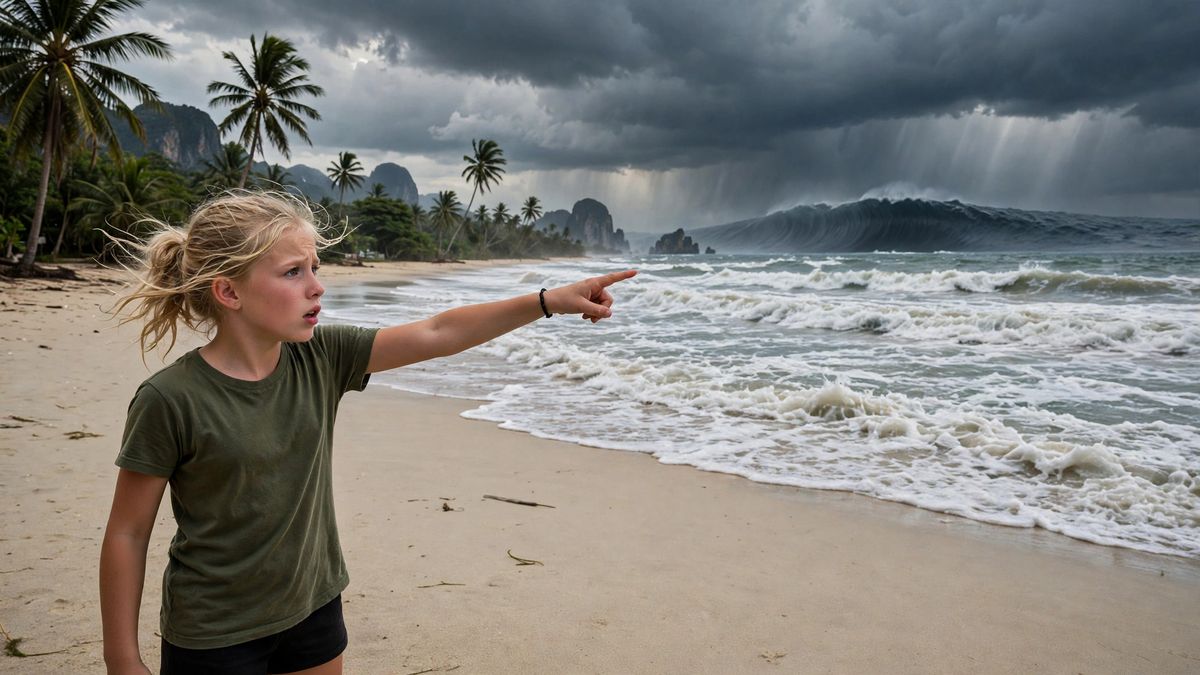
On the morning of December 26, 2004, Tilly Smith was enjoying the kind of holiday most children only dream about: a Christmas trip to Thailand with her parents and younger sister, staying at a resort on Mai Khao Beach in Phuket. She was ten years old, and she was walking along the sand with her mother when she noticed that the sea looked wrong.
"The water was bubbling"
The tide had gone out — far out, farther than it should. The water at the shoreline was sizzling and frothing, covered in bubbles, and it kept retreating instead of coming back in. Most people on the beach watched with curiosity. Some walked toward the exposed seabed. But Tilly felt a chill of recognition, because just two weeks earlier, back home in Surrey, England, her geography teacher Andrew Kearney had taught her class about tsunamis — and had shown them exactly these warning signs on film: the sea drawing back, the water bubbling like the top of a fizzy drink.
Tilly told her mother the sea was about to surge back in a giant wave. Her mother didn't immediately grasp it. So Tilly insisted — louder, more urgently, close to tears. She described what her teacher had shown them. She would not be calmed. And her parents, to their everlasting credit, listened to their ten-year-old.
Minutes that saved a hundred lives
The family raised the alarm with hotel staff, who took the warning seriously and began clearing the beach. Swimmers were called in, guests were moved to higher floors of the hotel, and the sand emptied — minutes before the first great wave of the Indian Ocean tsunami crashed into Mai Khao Beach, smashing everything in its path.
That day, the tsunami killed more than 200,000 people around the Indian Ocean, including thousands in Thailand. But on Mai Khao Beach, thanks to a schoolgirl who remembered her lesson and refused to be ignored, not a single person died. Around a hundred people were on that beach. Every one of them survived.
Tilly later said she was simply remembering what she had been taught. Knowledge, it turns out, can be a life jacket — if someone is brave enough to shout about it.
The Angel of the Beach
Thai newspapers named her the "Angel of the Beach." She was honored by the United Nations, invited to speak about disaster education, and even had an asteroid named after her — 20002 Tillysmith. Her teacher's lesson became a global argument for teaching children how to read the signs of natural disasters: children listen, children remember, and sometimes children are the only ones who know.
The lesson that traveled around the world
What saved Mai Khao Beach was not luck; it was a chain of people doing the right thing. A teacher in Surrey, Andrew Kearney, had taken ten minutes of class time to show his pupils film of a tsunami's warning signs — the sucking back of the sea, the strange foam — and to tell them: if you ever see this, run, and shout. A student remembered. Her parents believed her instead of brushing her off. Hotel staff acted on a child's word without waiting for official confirmation. Every link in that chain mattered, and the weakest-looking link — a ten-year-old on holiday — proved the strongest. In the years since, Tilly's story has been used by UNESCO and disaster educators worldwide to argue that teaching children about natural hazards is not a luxury in the curriculum. It is lifesaving equipment. Tilly herself returned to Thailand for memorial events and met people who had been on that beach — living proof, walking around in the sunshine, of what one remembered lesson can do.
Tilly Smith grew up, studied, and built a life far from that beach. But every Boxing Day, her story is told again — of the morning a ten-year-old girl looked at a strange, bubbling sea, thought of her classroom two weeks before, and saved everyone around her by speaking up.