In 2001, a devastating famine swept Malawi. In the village of Wimbe, fourteen-year-old William Kamkwamba watched his family's maize crop fail and their savings vanish — and then came the blow that hurt most: his parents could no longer afford the $80 a year in school fees. William, who loved learning and dreamed of becoming a scientist, was forced to drop out while his friends went back to class without him.
The library and the picture
Determined not to let his education die, William began visiting a tiny library at the local primary school, where he read everything he could find. In a science textbook called Using Energy, he saw a photograph of a windmill — a machine that could pump water and generate electricity from nothing but moving air. Staring at that picture, the boy made a decision that his whole village would soon talk about: he would build one.
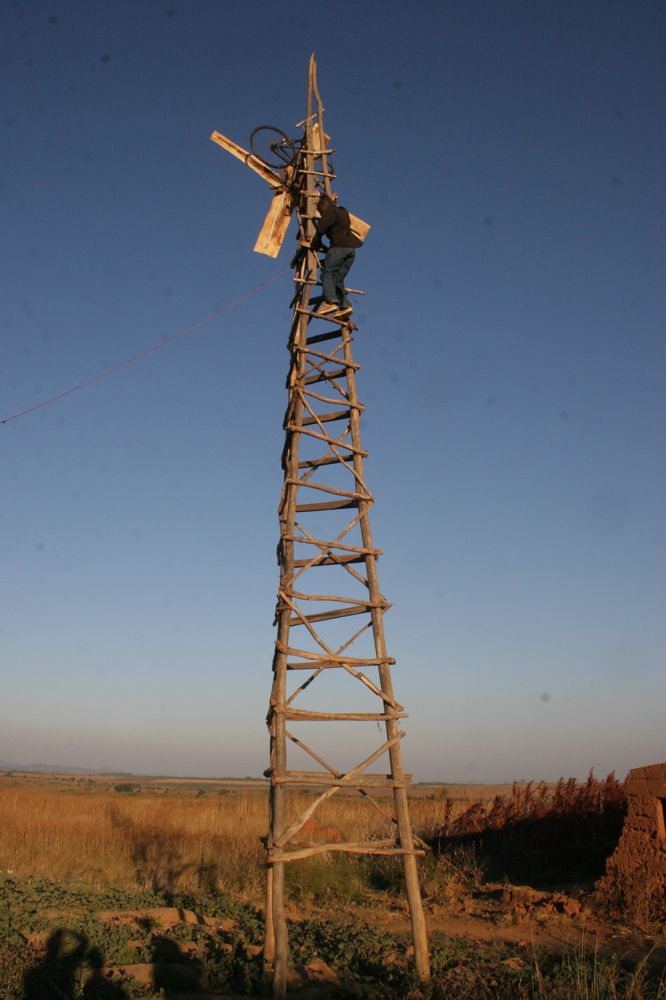
William became a familiar sight in scrapyards, hunting through junk for anything useful: a rusted bicycle frame and dynamo, a tractor cooling fan, PVC pipes, rubber belts, and timber from blue gum trees. His mother worried. Neighbors laughed at the crazy boy collecting garbage. He kept building anyway, working out the physics from the borrowed book as he went, climbing a tower of lashed-together poles with his strange machine in his hands.
Light in the darkness
When the blades first turned and a small bulb flickered on, a crowd gathered. The windmill powered lights and radios in the family home — the first electricity the house had ever known. William went further: a second, larger windmill drove a pump that drew water up from a well, bringing irrigation to gardens in the dry season — the difference, in a hungry land, between surviving and starving. The boy the village had mocked was now the boy they came to for help charging their phones and fixing their radios.
William later wrote that he had been given a choice: he could wait for the world to change — or try to change it himself, with what he had.
From Wimbe to the world
Word of the windmill boy reached journalists, then the world. In 2007 William told his story on the TED stage in Tanzania, visibly nervous, to a standing ovation. Donors and mentors helped him return to school; he eventually graduated from Dartmouth College in the United States. His memoir, The Boy Who Harnessed the Wind, written with Bryan Mealer, became an international bestseller and a feature film — and William has spent his adult life bringing innovation education back to young people in Malawi.
The boy in the scrapyard
To picture William's project properly, picture the materials: a broken bicycle, a rusted tractor fan blade, plastic pipes melted and reshaped, a dynamo his friend Gilbert helped him buy, and poles cut from blue gum trees — all assembled by a boy who had never seen a working windmill outside a textbook photograph, and who was translating the physics in his head as he built. His first machine was small, enough to light a single bulb, and the moment it flickered on, the mocking laughter in Wimbe turned to wonder. Word traveled the way it does in Malawi — on foot, by bicycle, by radio — until a reporter from the Daily Times drove out to see the windmill boy for himself. The story jumped to blogs and then to the world. Through it all, William kept repeating the philosophy that built the machine: he had tried, and he had made it. Three words at a time — try, and make it — he has since carried to young inventors across Africa.
His story began with everything taken away: school, food, future. What remained was a library card, a photograph of a windmill, and a boy stubborn enough to believe that scrap metal and wind could save his family. He was right — and he proved that genius is not a place or a privilege. Sometimes it is a hungry kid in a junkyard, refusing to stop learning.